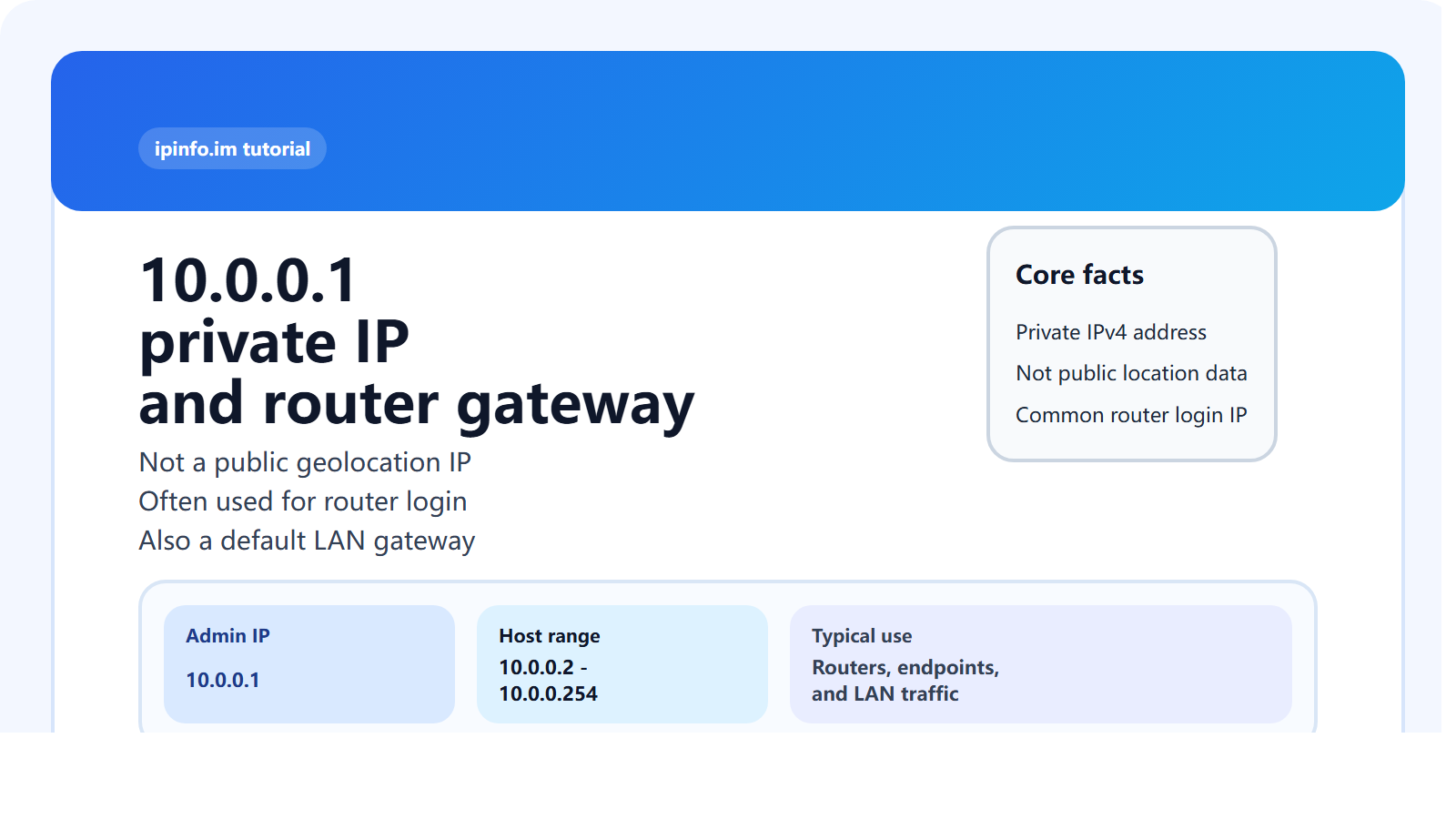
10.0.0.1 is usually not a public internet IP from a real city or ISP geolocation result. In most cases, it is a private LAN address used as a router login IP, default gateway, or internal network control address.
If your search intent is “what is 10.0.0.1” or “can 10.0.0.1 be geolocated,” the plain answer is no in the public-IP sense. It belongs to the RFC 1918 private IPv4 space.
What is 10.0.0.1?
10.0.0.1 is a private IPv4 address inside the larger 10.0.0.0/8 block. That private space covers 10.0.0.0 through 10.255.255.255 and is commonly used for internal communication in corporate networks, home routers, hotel Wi-Fi, campus networks, and virtualized environments.
In many practical setups, 10.0.0.1 is configured as the default gateway for a local subnet. Devices such as PCs, phones, NAS boxes, printers, cameras, and TVs may use it as the route out of the LAN or as the local admin page address.
Why is 10.0.0.1 commonly used for router login?
Routers need a stable internal management address so devices on the local network can reach them. Common defaults include 10.0.0.1, 192.168.0.1, and 192.168.1.1.
What do 10.0.0.0 - 10.0.0.255 usually mean in a subnet?
| Address | Typical role | Note |
|---|---|---|
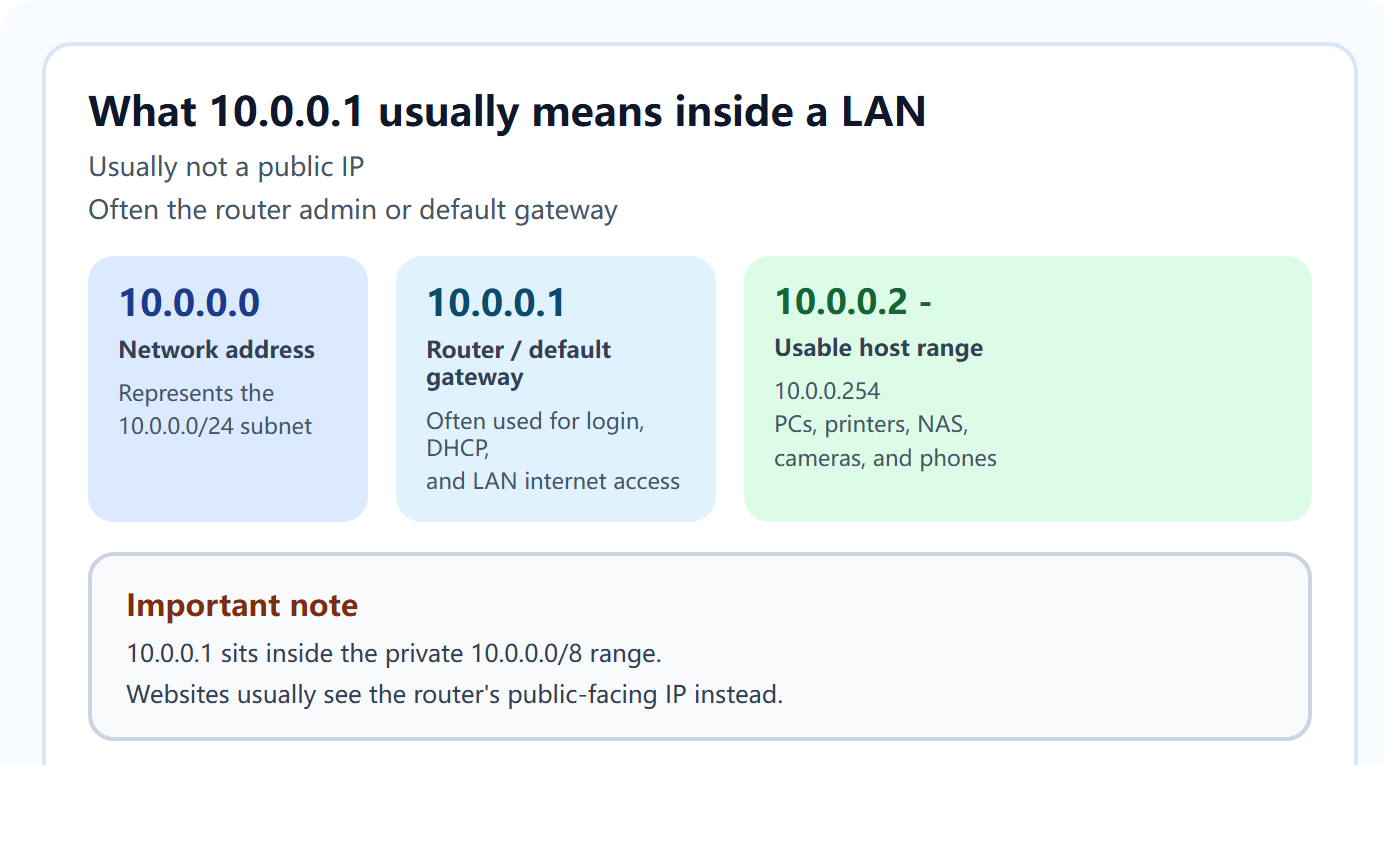
10.0.0.0 | Network address | Represents the subnet itself in a typical /24 LAN |
10.0.0.1 | Router / gateway | A very common private admin and default gateway IP |
10.0.0.2 - 10.0.0.254 | Usable host range | PCs, phones, printers, cameras and other LAN devices |
10.0.0.255 | Broadcast address | Usually reserved and not assigned to one device |
Can 10.0.0.1 be geolocated?
Normally no. It is not a public internet IP, so geolocation databases do not map it to a meaningful country, city, or ISP result.
What is the difference between 10.0.0.1 and a public IP?
10.0.0.1is a private internal address used only inside LAN or internal network environments.- A public IP is assigned by an ISP or cloud provider to an internet-facing interface and can be seen by external websites.
- Region labels in SEO, analytics, fraud review, or traffic logs are usually based on the public IP, not
10.0.0.1. - If logs only show
10.0.0.1, the real client IP may be hidden behind reverse proxy or load balancer headers.
Common uses of 10.0.0.1
- Home or office router admin address
- Default LAN gateway
- Internal DHCP or DNS forwarding node
- Private entry point in hotel, school, or enterprise networks
- Internal source address visible in proxy, VM, or container logs
Sample 10.0.0.* addresses
10.0.0.0    10.0.0.1    10.0.0.2    10.0.0.3    10.0.0.4
10.0.0.5    10.0.0.6    10.0.0.7    10.0.0.8    10.0.0.9
10.0.0.10    10.0.0.11    10.0.0.12    10.0.0.13    10.0.0.14
10.0.0.15    10.0.0.16    10.0.0.17    10.0.0.18    10.0.0.19
10.0.0.20    10.0.0.21    10.0.0.22    10.0.0.23    10.0.0.24
10.0.0.25    10.0.0.26    10.0.0.27    10.0.0.28    10.0.0.29
10.0.0.30    10.0.0.31    10.0.0.32    10.0.0.33    10.0.0.34
10.0.0.35    10.0.0.36    10.0.0.37    10.0.0.38    10.0.0.39
10.0.0.40
What if 10.0.0.1 does not open?
- Make sure you are connected to the right router by Wi-Fi or Ethernet.
- Verify that your current default gateway is actually
10.0.0.1and not another LAN IP. - Check whether the router redirects to HTTPS or uses a non-default port.
- On enterprise networks,
10.0.0.1may be only an internal gateway and not an admin page. - If you see it in server logs, continue checking headers like
X-Forwarded-ForandX-Real-IP.
FAQ
1. Is 10.0.0.1 a public IP?
No. It is a private IPv4 address used for internal networks.
2. Where is 10.0.0.1 located?
Usually not in a city-level public-IP sense. It generally represents a router or internal gateway inside a local network.
3. Why does typing 10.0.0.1 open my router?
Because many routers use it as the default local admin page.
4. Why do my website logs show 10.0.0.1?
Often because an internal proxy, container network, or load balancer recorded a private source address instead of the real client public IP.
Conclusion
10.0.0.1 is usually a private internal address, not a public geolocatable internet IP. Its most common role is router login or default gateway inside a LAN. If you need your real outward-facing IP, location, or ISP data, inspect the public internet IP instead of 10.0.0.1.